Available models
The following pre-trained UPET models are available:
Name |
Level of theory |
Available sizes |
To be used for |
Training set |
|---|---|---|---|---|
PET-MAD-1.6 |
r2SCAN |
XS, S, M |
materials, surfaces & molecules (102 elements) |
OMat → MAD-1.6 |
PET-MAD-1.5 |
r2SCAN |
XS, S |
materials & molecules (102 elements) |
OMat → MAD-1.5 |
PET-OAM |
PBE (Materials Project) |
L, XL |
materials (89 elements) |
OMat → sAlex+MPtrj |
PET-OMat |
PBE |
XS, S, M, L, XL |
materials (89 elements) |
OMat |
PET-OMATPES |
r2SCAN |
L |
materials (89 elements) |
OMat → MATPES |
PET-SPICE |
ωB97M-D3 |
S, L |
molecules (17 elements) |
SPICE |
PET-OMol |
ωB97M-V |
S, M, L |
molecules (83 elements) |
OMol25 |
PET-MOLS |
PBE0+MBD |
S |
organic molecular crystals (12 elements) |
CSD subsample |
Recommended usage:
PET-MAD v1.6.0 for molecular dynamics simulations of materials, surfaces, interfaces, solutions, metal complexes and other challenging systems.
PET-OAM for materials discovery tasks (convex hull energies, geometry optimization, phonons, etc.).
PET-SPICE for accurate and fast simulations of molecules and biomolecules.
PET-OMol for simulations of molecules, metal complexes and electrolytes.
PET-MOLS for organic molecular crystals, in particular NMR crystallography.
What’s new in PET-MAD-1.6
PET-MAD-1.6 is trained on the MAD-1.6 dataset, which extends MAD-1.5 with catalytic surfaces. Compared to PET-MAD-1.5, it therefore has better accuracy for surface reactions and adsorption energies, while keeping the same coverage of 102 elements at the r2SCAN level of theory. In addition:
A new M size (
pet-mad-m) complements the existing XS and S models, trading a higher evaluation cost for better accuracy (see Model sizes below).Compared to v1.5, all models have increased number of neighbors in the adaptive-cutoff graph construction, which substantially increases the accuracy in certain cases, especially for the XS size.
All three sizes ship LLPR uncertainty and shallow-ensemble heads, so energy, force and stress uncertainties are available out of the box (see Uncertainty quantification).
The models use the
'solver'adaptive-cutoff method instead of the'grid'method of PET-MAD-1.5, which makes them compatible withtorch.compileand hence with the compiledUPETWrapperbackend (see NVIDIA ALCHEMI Toolkit).
See the preprint for the dataset and benchmark details.
The PET-MAD-1.5 models (XS and S) remain available and can still be requested explicitly:
from upet.ase import UPETCalculator

calculator = UPETCalculator(model="pet-mad-s", version="1.5.0", device="cpu")
Model sizes
The XS / S / M / L / XL suffixes correspond to a fixed family of architecture hyperparameters, introduced as the PET-OMat Pareto front in Bigi et al., 2026 (Table IV, Appendix A). The same naming convention is reused for the other UPET families (PET-MAD, PET-OMAD, PET-OMATPES, PET-SPICE), so that e.g. PET-MAD-S and PET-OMat-S share the same architectural budget. Please note, that for PET-MAD-1.6 XS, S, and M sizes the number of neighbors in the adaptive-cutoff graph construction is increased compared to previous models, the old values are therefore reported in parentheses in the table below.
Hyperparameter |
XS |
S |
M |
L |
XL |
|---|---|---|---|---|---|
Parameter count |
4.5 M |
25.9 M |
109 M |
255 M |
730 M |
Node feature dimension |
512 |
1024 |
1536 |
2048 |
2560 |
Edge feature dimension |
128 |
256 |
384 |
512 |
640 |
GNN layers |
2 |
3 |
3 |
4 |
5 |
Transformer (attention) layers |
1 |
1 |
2 |
2 |
3 |
Graph cutoff radius (Å) |
7.5 |
8.0 |
8.5 |
9.0 |
10.0 |
Adaptive neighbor number |
16 (8) |
24 (16) |
32 (24) |
32 |
40 |
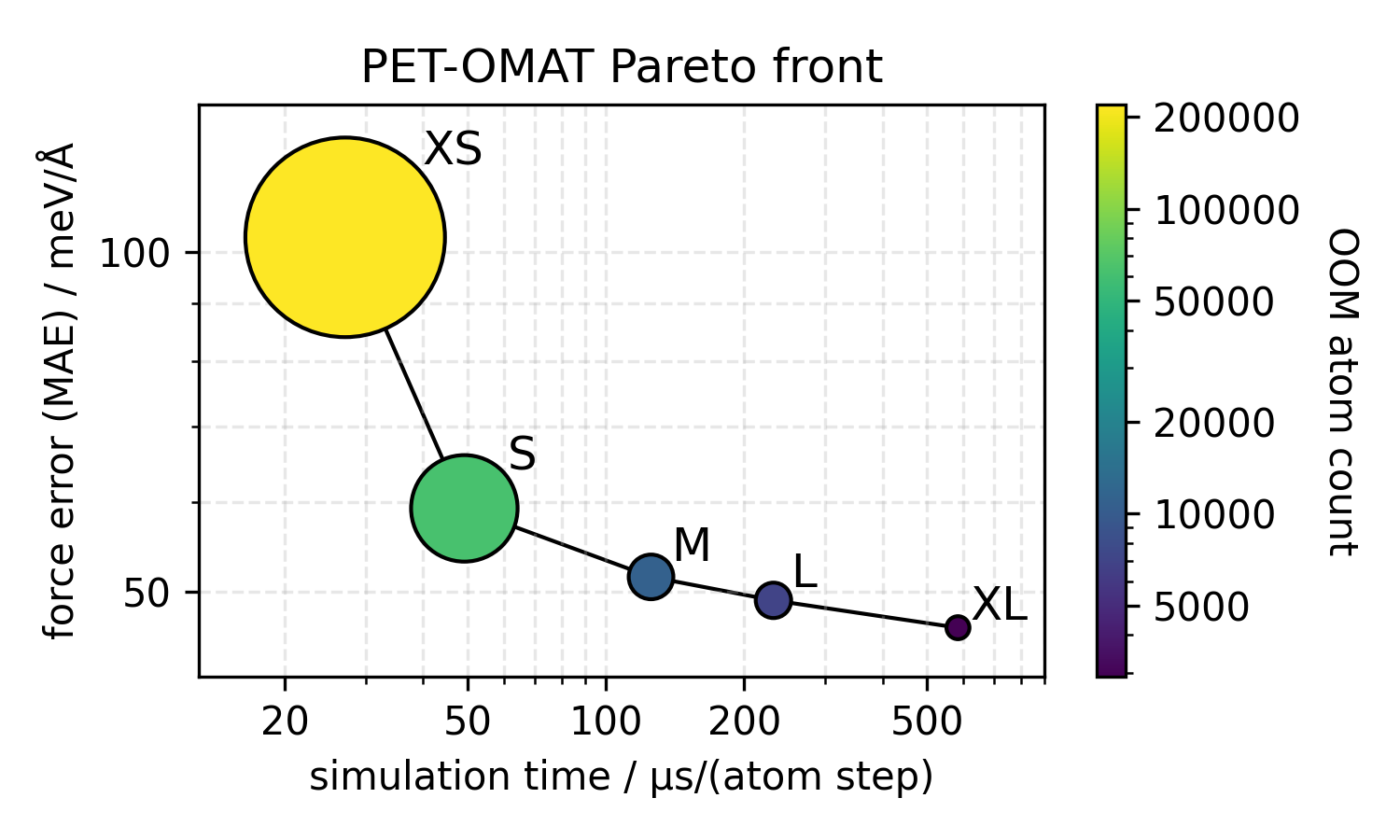
Larger sizes are more accurate but also more expensive and have a lower maximum system size before running out of GPU memory — see Fig. A2 in the reference above for the accuracy / cost / memory Pareto plot. As a rule of thumb, S is a good default for molecular dynamics, while L / XL are preferred for materials discovery workflows where accuracy dominates cost.
Model speeds
Seeing the parameter counts of our larger models, it would be tempting to think that the models are slow. This is not the case, as we use our parameters in a very sparse manner. Here we present a few benchmarks.
First, we present a benchmark of the top three open-source models on Matbench Discovery (as of Jan 14, 2026), replacing eSEN by its successor UMA-M. These were run on an H100 GPU (96GB VRAM). The structures are aluminum cells of increasing sizes and report time per energy/conservative force evaluation (lower is better). The NequIP model ran out of memory during the evaluation of the large structure (hence the missing point on the right).
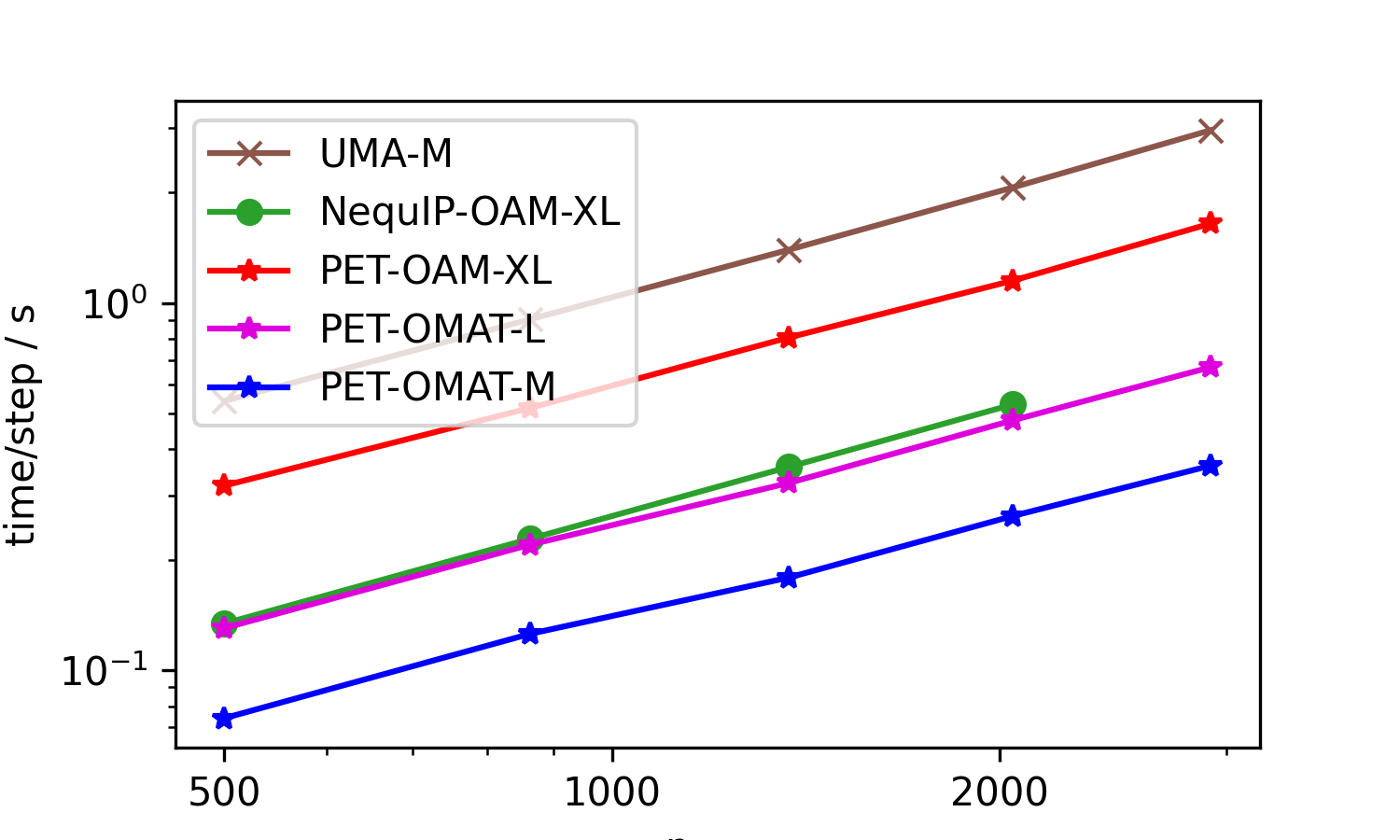
Besides the large PET-OAM-XL model, the figure also shows timings for two OMat24-trained models that are smaller (and faster). To get a sense of the speed-accuracy tradeoff, as well as the memory requirements of the entire PET-OMAT family, we also show a Pareto plot comparing cost and OMat24 validation errors
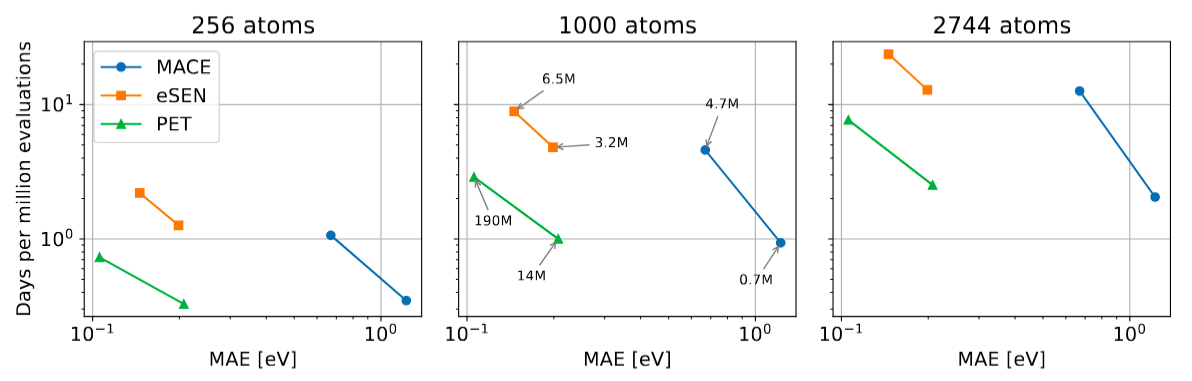
Finally, we present a benchmark we ran on carbon structures using models trained on the SPICE dataset. This benchmark was run on an A100 GPU (cf. this preprint for details on the models being compared).
Uncertainty quantification
The following checkpoints expose per-structure energy uncertainty
estimates through get_energy_uncertainty()
and get_energy_ensemble(), and the
corresponding force and stress quantities through
get_forces_uncertainty(),
get_forces_ensemble(),
get_stress_uncertainty() and
get_stress_ensemble()
(LLPR + shallow-ensemble heads, see Uncertainty quantification for usage):
pet-mad-xsv1.6.0pet-mad-sv1.6.0pet-mad-mv1.6.0pet-mad-xsv1.5.0pet-mad-sv1.5.0pet-mad-sv1.0.2pet-mols-sv1.0.0pet-mols-sv1.1.0
Calling these methods on other checkpoints will raise an error;
supports_uncertainty tells whether
the model at hand provides them.
Non-conservative forces
All UPET checkpoints support conservative forces (the derivative of the
predicted energy). Most also expose a direct, non-conservative force head
that is 2–3x faster at inference; see Non-conservative (direct) forces and stresses. The
following checkpoints are conservative-only and therefore do not
support non_conservative=True:
pet-mad-sv1.0.2pet-spice-sv0.2.0pet-spice-lv0.2.0pet-mols-sv1.0.0pet-mols-sv1.1.0
PET-MAD-DOS
In addition to the energy/force models above, UPET ships PET-MAD-DOS,
a separate model family for predicting the electronic density of states,
Fermi levels and bandgaps via
PETMADDOSCalculator (see
DOS, Fermi levels and bandgaps (PET-MAD-DOS)).
Version |
Level of theory |
Supported outputs |
Notes |
|---|---|---|---|
1.0 |
PBE (Materials Project) |
DOS, Fermi level, bandgap |
Latest stable |
See How et al., 2025 for the methodology.
Legacy models
For reproducibility or to cover specific use cases, we also provide a few additional models. These are expected to have worse performance than the models above.
Name |
Level of theory |
Available sizes |
To be used for |
Training set |
|---|---|---|---|---|
PET-MAD-1 |
PBESol |
S |
materials & molecules (85 elements) |
MAD-1.0 |
PET-OMAD |
PBESol |
XS, S, L |
materials & molecules (85 elements) |
OMat → MAD-1.0 |
All checkpoints are available on the HuggingFace repository.